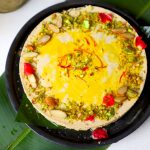
Sugar Free Bhapa Doi Recipe
Bhapa Doi is a no-bake, no-fuss Indian Cheesecake – a testament to the idea that the best things in life are often the simplest.
Calories: 797kcal
Equipment
- Colander
- Steamer
- 6 inch round cake tin
Ingredients
- 1 kilogram curd (get recipe)
- ⅓ Cup date syrup
- 1 teaspoon cardamom powder
- ¼ teaspoon saffron strands
- 1 tablespoon chopped pistachio
Makes: 6inch round
Instructions
- Place the curd in a muslin cloth or a fine-mesh sieve lined with cheesecloth. Hang it or place it over a bowl to drain the excess whey for at least 1-2 hours. This step is crucial for achieving a firm, creamy consistency.
- In a large bowl, whisk the hung curd with date syrup, soaked saffron, and cardamom powder until it’s smooth and lump-free. The mixture should be homogenous and creamy.
- Grease a heat proof bowl or individual ramekin cups. Line the bowl with parchment paper. Pour the whisked curd gently into a greased bowl. Tap once or twice on kitchen counter to remove trapped air.
- Cover the bowl with aluminum foil to prevent water from dripping into the dessert during steaming.
- Bring about 2-3 inches of water to a boil in a large pot or steamer. Place a trivet or a stand inside the pot. Cover and let steam start forming. Carefully place the covered bowl of curd on the trivet. Cover the pot with a tight-fitting lid and steam on medium-low heat for 20-25 minutes.
- The Bhapa Doi is done when it’s set and firm to the touch. You can do a simple test by inserting a toothpick or a knife—it should come out clean. Turn off the heat and let the Bhapa Doi cool down completely at room temperature.
- Once cooled, transfer it to the refrigerator and chill for at least 2-3 hours. Once chilled, gently unmold the Bhapa Doi onto a serving plate or serve it directly from the ramekins.
- Garnish with chopped nuts like pistachios, almonds, rose petals, and a few saffron strands. Serve chilled.
Video
Notes
- Make sure curd is not sour, thin, or too watery. It should be thick and creamy.
- You can use condensed milk, liquid jaggery, or caramel also. In the traditional bhapa doi recipe, either homemade caramel or condensed milk is used.
- If you’re using thick Greek yogurt, you can skip this step of draining and hanging.
- Using an Instant Pot: Follow the pressure cooker method using the “Steam” function for about 15-20 minutes, with the vent in the “Sealing” position.
Nutrition
Calories: 797kcal | Carbohydrates: 87g | Protein: 38g | Fat: 36g | Saturated Fat: 21g | Polyunsaturated Fat: 2g | Monounsaturated Fat: 11g | Cholesterol: 130mg | Sodium: 461mg | Potassium: 1971mg | Fiber: 5g | Sugar: 78g | Vitamin A: 1026IU | Vitamin C: 6mg | Calcium: 1245mg | Iron: 2mg