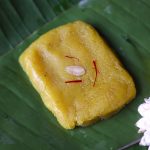
Karnataka Style Badam Halwa Recipe
There are desserts, and then there is Badam Halwa— rich, aromatic, and loaded with warmth of saffron and ghee, it is a staple at Karnataka weddings.
Servings: 6 adults
Calories: 641kcal
Equipment
- Mixer Grinder
- Heavy Bottom Kadhai
Ingredients
- 500 gram almonds (badam)
- 2 Cup full-cream milk (full fat milk)
- ¼ Cup ghee
- ⅓ Cup granulated white sugar
- 1 teaspoon green cardamom powder
- ¼ teaspoon saffron strands (kesar)
Instructions
Prep Work
- Bring about 2 cups of water to a boil, turn off the heat, and submerge the raw almonds in it. Cover and let them soak for 30 to 45 minutes (or overnight in room-temperature water).500 gram almonds (badam)
- Pinch the almonds gently; the skins will slip off effortlessly. Pat them completely dry using a clean kitchen towel to remove excess moisture.
- Using mortar and pestle crush the saffron strands slightly. Warm 2 tablespoons of milk slightly and add the saffron strands to it. Set it aside for 15 – 20 minutes.¼ teaspoon saffron strands (kesar)
Prepare Halwa
- Transfer the peeled, dried almonds into a blender jar. Add room temperature milk (milk adds a creamier texture) and grind into a smooth, fine paste. Give paste a stir with spatula while blending to get the desired texture instead of adding too much milk or water.2 Cup full-cream milk (full fat milk)
- Heat a heavy-bottomed pan or kadai (a non-stick or heavy cast-iron pan works best to prevent sticking) on medium-low heat. Add about half of the ghee.¼ Cup ghee
- Pour in the ground almond paste. Immediately switch the flame to low and stir continuously using a wooden or silicone spatula. This requires patience and time.
- As the moisture evaporates, the mixture will begin to thicken. This requires patience—expect about 20 to 25 minutes of continuous stirring so the bottom doesn’t burn and the almonds paste gets even heat and cooking.
- Once the raw smell of almonds disappears, the mixture looks slightly glossy, thick and most importantly starts leaving the pan – add saffron infused milk, and cardamom powder. Cook for 10 minutes. The colour will instantly transform into a gorgeous golden-yellow.1 teaspoon green cardamom powder
- Once all the liquid is evaporated and halwa starts coming together, add sugar. Stir to combine. As the sugar melts, the halwa will loosen up again into a flowing consistency. Keep stirring on low heat.⅓ Cup granulated white sugar
- Begin adding the remaining ghee one tablespoon at a time at regular intervals.
- Turn off the heat once the halwa forms a cohesive mass that easily rolls off the spatula without sticking. Top with sliced almonds and a few extra saffron strands. Serve badam halwa warm or at room temperature.
Avoid making it too coarse, as traditional Karnataka-style halwa has a silky-smooth, uniform mouthfeel.
When the paste hits the pan, it might form small lumps. Whisk or stir vigorously with your spatula to break them down into a smooth, liquid batter.
Watch closely as the halwa absorbs the ghee, turns glossy, and starts leaving the sides of the pan.
Video
Nutrition
Calories: 641kcal | Carbohydrates: 33g | Protein: 20g | Fat: 52g | Saturated Fat: 9g | Polyunsaturated Fat: 11g | Monounsaturated Fat: 29g | Trans Fat: 0.01g | Cholesterol: 29mg | Sodium: 32mg | Potassium: 737mg | Fiber: 11g | Sugar: 19g | Vitamin A: 133IU | Vitamin C: 0.1mg | Calcium: 326mg | Iron: 3mg